

Most fall roof repairs start the same way: a leak after the first big rain, a ceiling stain that wasn’t there last week, or a gutter spilling water where it shouldn’t. Then come two questions. How do you keep more water out right now, and how much of the roof actually needs work?
Those are separate decisions. A tarp buys time, a targeted repair fixes a localized problem, and replacing the roof makes sense when it’s failing in several places. In that last case, another patch can mean paying twice.
This guide is for Greater Seattle homeowners facing those choices after a fall storm or a new leak. It covers what to do first, the most common fixes, and how to tell when a tarp, a repair, or a new roof makes the most sense.
Contents
At Handy Andy Restore and Repair, we’re a family-owned contractor in Federal Way, and we handle roof repairs and replacements, including emergency tarping, across Greater Seattle. Here’s how we weigh each option, and what to ask whoever you hire.
Quick answer: Repair when the problem is localized and the roofing around it is sound. Replace a section when the damage runs past a small patch but the rest of the roof is in good shape. Replace the whole roof when it’s failing in several places or patches keep failing. A tarp is temporary protection, not a repair.
Why Fall Repairs Shouldn’t Wait
Greater Seattle’s climate is hard on roofs: long wet seasons, shade and needles from tall evergreens, and fall windstorms that can lift or tear off shingles. As the wet season builds through fall, weak spots start to show. Leaves and needles collect along the roof edge and in valleys, and a loose shingle or failing flashing gets tested by storm after storm. Catching a problem early is often cheaper than repairing the insulation and drywall below it after water gets in.
Timing Your Repairs
Early fall also gives you better working weather. It usually brings more dry days and milder temperatures than midwinter, which matters if part or all of the roof needs replacing before winter, because shingle sealant needs heat to bond, which gets harder once cold weather sets in (more on that below).
Signs of Roof Trouble to Look For
A quick check from the ground, no ladder needed, is a good start. Look for:
- Missing, lifted, or curling shingles
- Shingle granules in the gutters
- Thick moss, which holds moisture against the shingles and can lift their edges
- Damaged flashing around chimneys, skylights, and vents
- Overflowing gutters
- Branches touching or hanging over the roof, which are worth trimming back before winter storms
A roofer’s inspection in the fall, and again after any major windstorm, catches what you can’t see from the ground.
Checking the Attic Before Winter
If you can get into the attic safely, look for water stains on the wood overhead, damp insulation, or daylight coming through. Any of these can mean water is already getting into the house. While you’re up there, make sure the vents aren’t blocked by insulation or debris. Good ventilation helps prevent condensation, and during a winter cold snap it helps prevent ice dams, which form when snow melts on a warm roof and refreezes at the colder edge.
What to Do When Your Roof Starts Leaking
Start inside, not up top. A wet roof is dangerous, and a ceiling stain doesn’t tell you where the water is getting in.
- Stay clear of hazards. Keep away from sagging or bulging ceilings and don’t poke into them. Stay away from wet light fixtures and outlets. The CDC’s guidance on flooded homes says never to switch power on or off, or use electric tools, while standing in water.
- Protect belongings. Move furniture and valuables away from the drip. Use a bucket only if you won’t be standing under an unstable ceiling.
- Document it. Take photos from a safe spot and note when the leak started, whether wind was involved, and whether that area has leaked before.
- Call for an assessment. Mention active dripping, missing shingles, fallen branches, or interior damage, and ask whether you need a temporary tarp before a permanent fix.
Finding the Source of a Roof Leak
The stain on your ceiling and the opening in your roof are often in different places. Water doesn’t always drop straight down, so the source may be directly above the stain or several feet away, as IKO explains in its leak-finding guide. IKO also notes that attic condensation and plumbing leaks can look like a roof leak.
Share what you’ve noticed: does it leak in steady rain, only in wind-driven rain, or even when it’s dry? Has it been repaired before? Then expect a roofer to check it from above and below in person, since some problems, like soft decking, can’t be judged until the roofing comes off. Before you approve any roof leak repair, ask what failed, what the roofer saw that tells them so, and whether the fix corrects the cause or only holds water back for now.
The Most Common Fall Repairs
Most leaks trace back to a few problems, and the fix should match the failure. A leak isn’t automatically a reason to reroof.
Shingle Repairs and Patches
When only a few shingles are missing, cracked, or lifted and the decking underneath is sound, replacing them is often enough. Ask exactly what a “patch” includes. A proper shingle repair job follows a simple process:
- Remove the damage. Take out the broken or damaged shingles and their old nails.
- Check underneath. Look at the exposed underlayment and decking, plus the surrounding shingles.
- Install matching replacements. Fasten new shingles that match the existing ones with new nails, then seal them.
A dab of sealant over a crack is a short-term measure, not a repair.
Flashing, Vent Boots, and Roof Transitions
Flashing is the metal that sheds water around chimneys, skylights, vents, and wall-to-roof joints, and a pipe boot seals around a pipe that passes through the roof. These details are common leak sources, so leaks can start even when the shingles look fine. Over time, flashing can rust, loosen, or pull away, and the rubber on pipe boots can crack. The repair might be a new boot, repaired or replaced flashing, or removing some adjacent shingles to rebuild the joint correctly. Watch for nails that have backed out, too. Raised nails can push shingles up and open a path for water, so a good repair resets or replaces those nails.
Repairing a Larger Area of Roof Damage
Sometimes the damage goes beyond a few shingles, say from a fallen branch or a long-running leak, but the surrounding area is still serviceable. If there’s a clean boundary between damaged and good roofing, replacing just that section can make sense. A section repair usually involves:
- Tear-off. Removing the roofing in the affected area.
- Decking. Replacing any rotted decking, the wood surface under the shingles.
- Rebuild. New underlayment, flashing, and shingles are installed.
- Tie-in. Blending the new section into the existing shingles so water sheds correctly across the seams. Ask your roofer how they handle this step.
Moss Growth and Removal
Moss grows easily on shaded shingle roofs and cedar shake roofs around Puget Sound, and it does more than look bad. GAF explains that moss soaks up rainwater instead of letting it drain, lifts shingles as it holds moisture, and strips the protective granules from asphalt shingles. IKO adds that moss can work its way under shingles. Once a shingle lifts, its seal can break, leaving it easier for wind to catch.
Removing it the wrong way causes damage too. For safe moss removal:
- Skip the pressure washer. Avoid using high-pressure washers on asphalt shingles. GAF says the spray can strip granules and lift shingles, and IKO says the spray can break a shingle’s adhesive seal.
- Use the right treatment. Proper moss removal means using a roof-safe, moss-specific treatment made for your roofing material, without bleach or harsh chemicals, and following its label.
- Protect your landscaping. GAF notes that many moss removal products can harm nearby plants.
Gutters, Valleys, and Debris
Clogged gutters and downspouts are blocked by leaves, needles, and shingle grit, so rainwater can’t drain away. The same debris collects in valleys, where two slopes meet. Heavy autumn rains then overflow them, sending water over the edge or behind the gutter, where it can soak the roof edge. On flat or low-slope sections, like a porch roof, blocked drains can leave water ponding on the surface.
IKO notes that clogged gutters rarely cause a leak on their own, but overflow makes any existing weak spot worse. Our roof and gutter cleaning can clear debris alongside a repair assessment, though cleaning won’t fix damaged flashing or rotted wood. Leave roof and gutter work to someone with proper fall protection.
Storm Damage and Emergency Roof Tarping
Emergency roof tarping limits water getting in when a permanent fix can’t happen right away, such as after storm damage from high winds or a fallen branch, or while the scope and a dry weather window are being lined up.
A tarp only works if it’s installed correctly. According to GAF’s tarping guide, a proper tarp installation:
- Covers enough area. Once installed, the tarp extends at least four to five feet past the damaged area.
- Stays put. It’s held down with wooden boards fastened with nails, which hold more securely than sandbags.
- Goes on in dry weather. GAF says never to install a tarp while it’s still raining.
- Stays temporary. GAF suggests keeping a tarp up three months at most, with a roofer checking it about a month in.
That’s why tarping is a job for a roofer. Working on wet shingles is a serious fall risk, not a weekend project. Don’t treat a tarp as the fix, either. Before the crew leaves, settle who will assess the permanent repair, and when.
Roof Repair or Replacement: How to Decide
One leak isn’t a reason to replace a roof. But the cheapest repair today isn’t always the cheapest way to protect the house over the next several years.
GAF’s repair-versus-replace guide weighs several factors: the roof’s age, how much of it is damaged, its repair history, and what a repair costs compared with reroofing. Its rules of thumb: replacing makes more sense when the repair bill would be more than 25 percent of the cost of a new roof, or when 30 percent or more of it is damaged. Below that, GAF considers repair reasonable on a roof about 15 years old or younger without a long repair history. GAF is a shingle manufacturer and these are rough guides, not formulas, but they make a useful sanity check on any quote.
Replacement deserves a serious look when you see these signs:
- Widespread problems. Issues are showing up in several areas instead of one.
- Worn shingles. Shingles are curling, cracking, or shedding granules across the whole roof.
- An aging roof. It’s near the end of its service life and has been repaired before.
- Damaged decking. The wood under the roofing is soft or rotted across a wide area.
- Repeat leaks. The same leak keeps coming back after it’s been fixed.
An isolated flashing failure on an otherwise healthy roof is a repair. Repeated leaks across worn-out slopes usually aren’t. Nobody can tell which from a ceiling photo, so we start with a hands-on look and the repair history. A good contractor should tell you when a repair is the reasonable choice, and we will.
Cedar shake roofs, common on older Puget Sound homes, need a closer look. As shakes age they can split, curl, and wear thin, and needles and debris left in the valleys hold moisture against the wood. When a number of shakes are failing, patching gets harder to justify, and it often makes more sense to replace the roof.
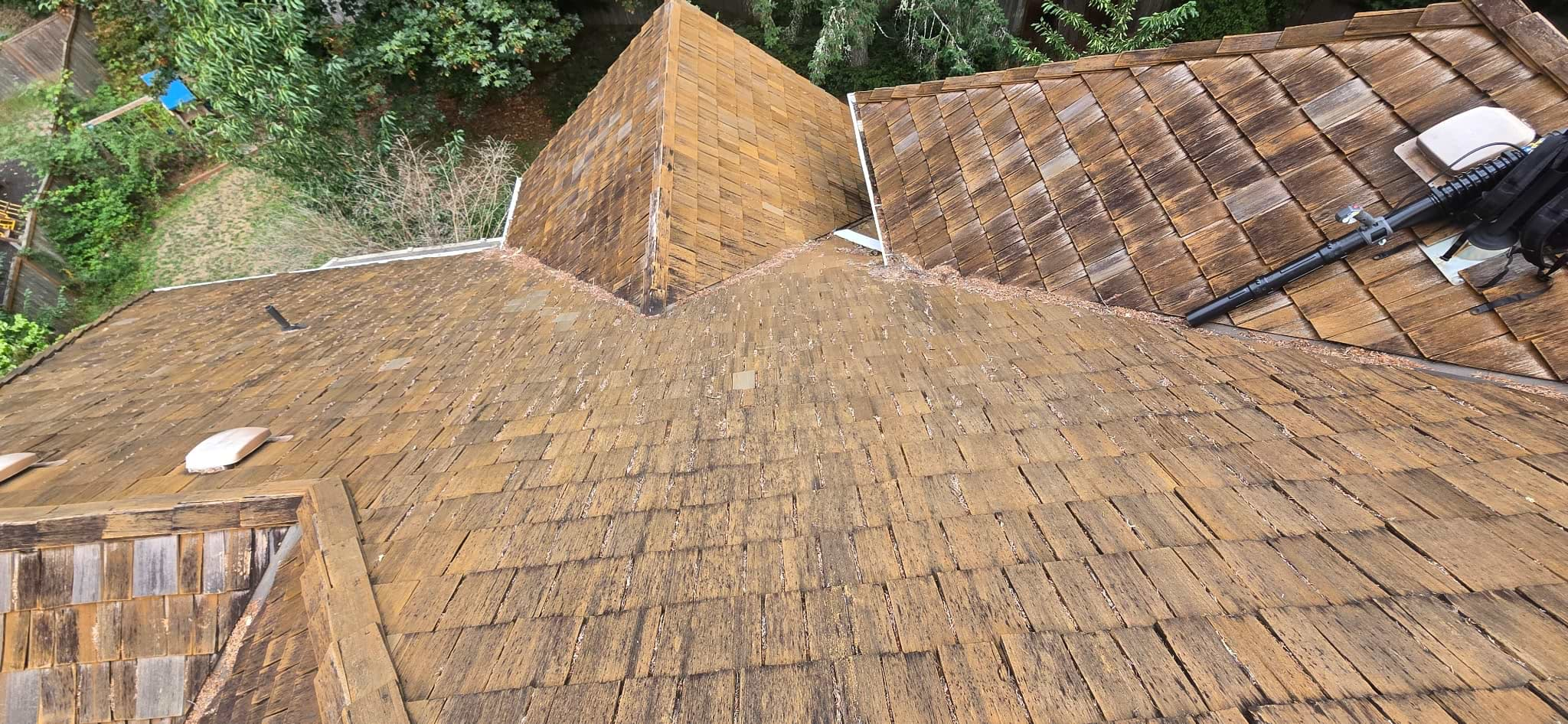
This Gig Harbor cedar shake roof had needles and debris built up in its valleys. Given its age and the condition of a number of shakes, the homeowner chose a full replacement over another round of repairs.
Can You Do a Roof Replacement in the Rainy Season?
Yes. A roof replacement in the rainy season doesn’t have to wait for summer, as long as the forecast, access, and the crew’s protection plan allow it.
That’s not the same as installing shingles during a downpour. IKO’s guidance on rainy-season installation lays out a simple process:
- Open a little at a time. Expose only a small area or one side, so it can be protected quickly.
- Stop when rain starts. Halt the installation and cover the exposed area.
- Let it dry. Once it stops, let wet decking dry before work continues.
On bigger roofing projects, ask the crew how much they’ll tear off at once, how they’ll protect it, and what happens if the forecast changes.
Cold weather matters too. GAF’s cool-weather installation guide recommends installing asphalt shingles at temperatures of 40°F or warmer. At lower temperatures, shingles lose flexibility and can crack, and the factory sealant strip, which needs the sun’s heat to activate, may not seal, so colder installs call for precautions such as hand-sealing each tab with approved roofing cement. With those precautions, a winter installation is possible, so the method matters more than the month. If conditions aren’t right, tarp the roof and reschedule, even if a full reroof has to move to spring.
How to Choose a Roofing Company and Compare Estimates
When you’re comparing quotes, look at what’s included, not just the bottom line. Getting two or three written estimates makes the differences easier to spot. A surface patch, a rebuilt flashing joint, and a replaced section are three different jobs, even when every quote calls it “roof repair.”
- Registration and insurance. Washington requires construction contractors to be registered with L&I. Look up the roofing company with L&I’s Verify a Contractor tool to confirm an active registration, bond, and workers’ comp account, and to check for safety citations. Then read recent reviews and ask for proof of liability insurance.
- Scope. The area being repaired, what’s removed and installed, and the intended result, with temporary protection listed separately from permanent work.
- Hidden damage. How rotted decking would be documented, priced, and approved before extra work starts. A written per-sheet price beats “we’ll handle whatever we find.”
- For replacements. A complete reroofing estimate should list:
- Tear-off of the old roofing
- Inspecting the decking
- Underlayment, flashing, and ventilation
- Cleanup and permit requirements
- Material and workmanship warranties
A reputable roofing company will put all of this in writing and answer your questions before you sign. It also helps to hire one with local experience. Long wet seasons, moss, and fall windstorms shape how Puget Sound roofs wear out, and a team that works here knows how to plan around them.
Don’t Skip the Interior Work
Stopping the leak doesn’t dry the insulation, framing, or ceiling below it. According to the EPA’s mold guide, wet materials and belongings should be dried within a day or two to keep mold from growing, so it pays to get the interior assessed quickly.
We also handle water damage restoration and the drywall and ceiling repair that follows, in this order:
- Stop the source. Repair or tarp the roof so no more water gets in.
- Dry what got wet. Dry the insulation, framing, and drywall, and remove what can’t be saved.
- Rebuild and repaint. Replace damaged drywall and ceilings, then prime and repaint.
Painting over a stain without fixing what caused it only hides the problem. If you’re working with an insurer, ask for roof and interior work to be itemized separately.
Fall Roofing Questions We Hear Most
The leak stopped when the rain did. Can it wait?
Not safely. A pause in dripping doesn’t mean the roof is fine or that everything has dried out, and the next storm will likely find the same opening. Schedule an assessment, and treat an active leak, a sagging ceiling, or any electrical concern as urgent.
Can roof repairs be done in the winter?
Often, yes. A Greater Seattle winter is usually more wet than frozen, apart from the occasional freeze or snow, so tarping, flashing and vent boot work, and small fixes on shingle roofs can be done on a dry day. Roofers need a dry roof to work safely, though, and snow or ice has to clear first, and shingles installed in cold temperatures may not seal properly. As noted above, GAF recommends installing shingles at temperatures of 40°F or warmer and hand-sealing them below that. If a repair can’t be done properly, a tarp can protect the roof until conditions improve.
How long should a roof repair last?
A tarp is temporary and a dab of sealant is short-term, while a rebuilt flashing joint or a replaced section is meant to be a permanent fix. How long any repair lasts depends on what was repaired and the condition of everything around it. Ask what warranty covers the workmanship, and be wary of any lifespan promise made without an inspection.
How much does a roof repair cost?
In Seattle, Angi reports an average roof repair cost of about $1,540, with most repairs between $454 and $2,655 and a major job reaching about $10,500, based on its August 2026 data. Nationally, Fixr puts the cost of fixing asphalt shingle roofs at $150 to $1,500 and metal roofs at about $500 to $2,000, and says labor typically makes up at least 60 percent of the bill. Your price depends on the size of the damage, the roofing material, how easy it is to get up there, and whether hidden damage turns up. Fixr also notes that most roofers charge extra for emergency service, so handling small problems before a storm can save money. A repair almost always costs less up front than reroofing. Whether it’s cheaper over time depends on the roof’s age and condition, which is where GAF’s 25 percent guideline helps.
A sagging or collapsed section is different. Keep everyone away from it and call for an emergency assessment. Structural damage costs far more than a typical repair because framing has to be rebuilt, and the price depends on how much of the structure is affected.
What is the 25 percent rule for roofing?
It can mean two different things. As a rule of thumb, GAF suggests replacing rather than repairing when the repair bill would be more than 25 percent of the cost of a new roof. Florida’s building code has its own 25 percent rule: there, repairing more than 25 percent of a roof within 12 months can require bringing the entire roof or section up to current code. That rule is specific to Florida, so ask your roofer what your local building department requires.
Will insurance cover roof repairs after a fall storm?
It may, if the damage was sudden and your policy covers the cause. Policies generally cover sudden damage, like wind tearing off shingles or a tree falling on the roof, but typically not leaks from wear and tear, age, or poor maintenance. The same applies to leaks after winter snow or ice: the cause, your policy’s exclusions, and your deductible decide what’s covered. Your insurer makes that call, while a contractor documents the damage and repair scope. The Washington Office of the Insurance Commissioner says you have the right to choose your own contractor, advises keeping receipts for emergency repair materials such as tarps, along with photos, and cautions you to understand any “assignment of benefits” form before signing, since it can let a contractor negotiate and settle the claim directly with your insurer.
How can I get my roof repaired if money is tight?
Start by protecting the house, since a tarp can buy time while you plan the repair. Then look at three options:
- Insurance. If the damage was sudden, like a fallen tree or storm damage, your policy may cover it.
- Local repair programs. Income-qualified homeowners may get help from King County’s Housing Repair Program, which offers deferred payment loans and emergency grants and can fund replacing a roof, or the City of Seattle’s Home Repair Loan Program, which offers 0% interest loans and some grants for roof repair or replacement. Seattle’s program currently has limited funds and a waiting list.
- Phased work. Ask your roofer whether the most urgent repair can be done first and the remaining work scheduled later.
Roofing Help in Federal Way and Greater Seattle
Handy Andy Restore and Repair is a licensed, bonded, and insured family-owned company serving homeowners in Federal Way, Seattle, and the surrounding Puget Sound area. Our roofing services include roof repairs, emergency tarping, and full replacements when that’s the better call.
If you have a leak, or want your roof checked before the wet season peaks, contact our team for a free estimate or call (206) 651-0241. Photos, the roof’s approximate age, and when the problem shows up give us a good starting point.